


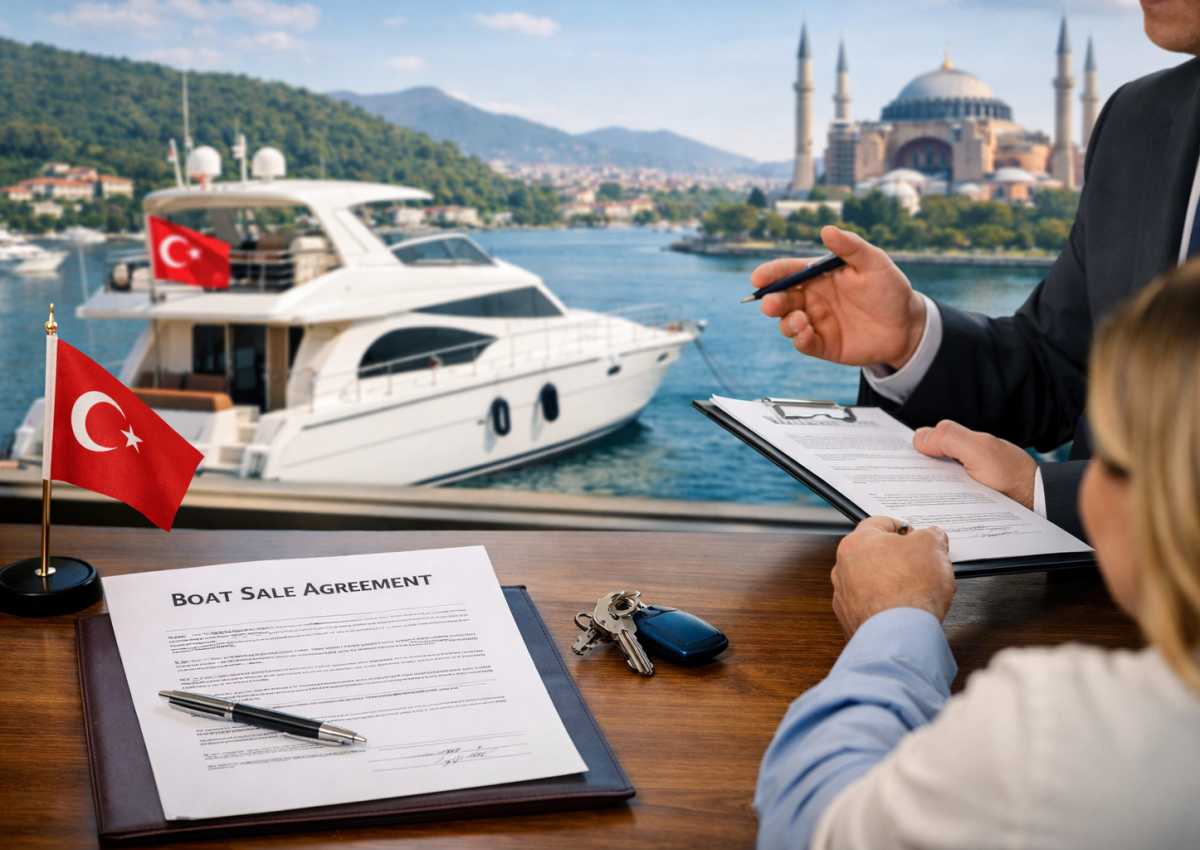
Turkey is one of the Mediterranean’s most popular boating destinations. Areas such as Fethiye, Göcek, Marmaris and Bodrum have thriving international sailing communities and a large market for new and used boats.
For foreign buyers, finding the right boat can be the easy part.
Before agreeing to a purchase, it is important to establish who legally owns the vessel, whether its documents are correct and whether any legal or administrative issues could affect the transfer.
The rules that apply can also depend on the vessel, its registration and the buyer’s individual circumstances.
This guide explains some of the legal checks foreign buyers should consider before buying a used boat in Turkey.
Can a Foreigner Buy a Boat in Turkey?
Foreign nationals may be able to purchase boats in Turkey, but the registration and flag requirements should be considered before completing the transaction.
Different registration systems apply to different types of vessels, and the buyer’s nationality and residence status may also be relevant.
For example, guidance published by the Turkish maritime authorities specifically provides procedures for foreign owners with residence permission in Turkey when dealing with vessels recorded in the Bağlama Kütüğü.
For this reason, foreign buyers should establish how the particular boat can be registered in their circumstances before committing to the purchase.
Check Who Actually Owns the Boat
One of the most important checks is also one of the simplest: make sure the person selling the boat has the legal authority to sell it.
The seller’s identity should correspond with the vessel’s official registration records.
If somebody is acting on behalf of the registered owner, their authority to complete the transaction should also be verified.
Do not rely solely on possession of the boat, marina records or an informal agreement as evidence of legal ownership.
Check the Boat’s Registration Documents
The boat itself should match its official documentation.
Depending on the vessel and registration system, relevant information may include details such as:
- the registered owner;
- vessel name;
- registration or identification details;
- dimensions and technical characteristics;
- engine details and serial number;
- registered home port.
Turkish maritime authorities may require photographs of the vessel and its engine serial number as part of registration and sale procedures.
Any unexplained difference between the physical vessel and its official records should therefore be investigated before the purchase proceeds.
Check for Liens, Restrictions or Other Legal Problems
Ownership is not the only issue that should be checked.
A buyer should establish whether there are any legal rights or restrictions affecting the vessel that could interfere with the purchase or create problems afterwards.
Depending on the circumstances, these might include a pledge, attachment, court order, finance arrangement or another third-party interest.
This is particularly important when purchasing a higher-value yacht or where the ownership history is complicated.
Identifying a problem before paying for the boat is considerably easier than trying to resolve one after the transaction.
Do I Need a Marine Survey?
A legal review and a marine survey perform different functions.
A lawyer can investigate matters such as ownership, documentation, contractual terms and legal restrictions.
A marine surveyor examines the physical condition of the vessel.
For a used boat, particularly a higher-value yacht, buyers may therefore wish to consider both.
A survey may identify structural, mechanical or other technical problems that would not necessarily appear in the vessel’s legal documentation.
Likewise, a boat that is technically in excellent condition could still have a problem with its ownership or paperwork.
Should I Pay a Deposit Before the Checks Are Complete?
Buyers should exercise care before paying a substantial deposit.
If a deposit is required, the written agreement should make clear what the payment represents and what happens if the transaction does not proceed.
For example, the parties may need to consider what happens if legal checks identify a problem with ownership or registration, or if a marine survey reveals a significant defect.
The appropriate terms will depend on the transaction.
Obtaining advice before signing a deposit agreement or transferring a substantial sum can help avoid uncertainty later.
What Should Be Included in the Boat Sale Agreement?
A written agreement provides both parties with a clear record of what they have agreed.
Depending on the transaction, it may address:
- the identities of the buyer and seller;
- details of the vessel;
- the agreed purchase price;
- deposit and payment arrangements;
- the date and conditions of transfer;
- equipment and accessories included in the sale;
- representations concerning ownership;
- the condition of the vessel;
- what happens if either party cannot complete the transaction.
The agreement should reflect the particular boat and transaction rather than relying on a generic template.
This becomes especially important with higher-value vessels or where significant equipment is included in the sale.
Make Sure You Know What Is Included in the Sale
Boats are often advertised with substantial additional equipment.
Navigation equipment, tenders, outboard engines, safety equipment and other items can represent a significant part of the overall value.
If particular equipment forms part of your decision to purchase the vessel, it is sensible to identify it clearly in the agreement.
An inventory can help avoid disagreements about what was supposed to remain with the boat when ownership changed.
What Happens After I Agree to Buy the Boat?
Reaching an agreement with the seller does not necessarily complete the legal process.
The appropriate registration procedure must also be followed.
Turkey’s maritime authorities use the Umurbey Maritime Citizen Portal for a range of vessel registration procedures. Applications and documentation can be submitted electronically for many transactions, while certain procedures still require an appointment with the relevant Harbour Master’s Office.
The exact procedure and documents required will depend on the vessel and its registration.
Buyers should therefore establish the requirements before agreeing a completion date.
Can I Buy a Boat in Turkey Without Being There?
In some circumstances, it may be possible to authorise another person to handle legal and administrative procedures on your behalf using a Power of Attorney. Check out our Power of Attorney article HERE
The authority required will depend on the transaction and the procedures that need to be completed.
If you live outside Turkey, obtaining advice before preparing the Power of Attorney is important. This can ensure that it contains the necessary authority and follows the appropriate formalities for use in Turkey.
Warning Signs When Buying a Used Boat
Not every irregularity means there is a serious problem, but buyers should investigate anything that does not make sense.
Warning signs may include:
- the seller’s details not matching the registration;
- unexplained differences between the boat and its documents;
- missing registration paperwork;
- uncertainty over engine identification or ownership;
- pressure to pay a large deposit quickly;
- reluctance to allow legal or technical checks;
- equipment advertised with the boat disappearing from the final agreement;
- unclear ownership history.
If something cannot be satisfactorily explained, it is usually better to resolve the issue before transferring money.
Why Carry Out Legal Checks Before Buying?
A used boat can represent a substantial investment.
Legal due diligence is intended to identify potential problems while the buyer still has the opportunity to decide whether to proceed.
Once the transaction has been completed and the purchase price paid, resolving an ownership, registration or contractual dispute can become considerably more difficult.
Early legal advice can also help establish the correct registration procedure and ensure that the sale agreement properly reflects what the parties have agreed.
Legal Assistance When Buying a Boat in Turkey
Burcu Yılmaz Law Office assists Turkish and international clients with legal matters relating to boat purchases and sales in Turkey.
Legal assistance may include reviewing ownership and registration documents, identifying potential restrictions, preparing or reviewing sale agreements and advising on the procedures required to complete the transaction.
For overseas buyers, assistance may also be available where a Power of Attorney is required to complete appropriate procedures in Turkey.
If you are considering buying a boat in Turkey, obtaining advice before signing an agreement or paying a substantial deposit can help identify potential problems at an early stage.
Further Information
If you are considering buying or selling a boat, you may also find our guide to buying or selling a boat in Göcek helpful.
If you live overseas and need someone to handle legal procedures in Turkey on your behalf, see our guide to arranging a Power of Attorney in Turkey from abroad.
Directorate General for Maritime Affairs
Boat Transfer in Turkey Guide: Legal Process for Buying or Selling a Boat
Umurbey Portal Boat Transfer Guide: Step-by-Step Process in Turkey


